65. Board games in 14th c. Italy
Europe’s upper class played four board games: chess, draughts, morris and tables. See the 2021 book written by Arie van der Stoep, Jan de Ruiter & Wim van Mourik entitled “Chess, Draughts, Morris & Tables. Position in Past & Present”.
Alessandro Arcangeli (2003), quoted by Robin O’Bryan [2019:34], drew attention to the frescoes in gaming rooms in several Italian castles, a trend that lasted into the 16th c. The castle near Arco, a town in the province Trentino in the north of Italy, is one of them.
The castle, originally under control of the counts of Arco, at least goes back all the way to the 12th c. In the 16th c. Emperor Leopold seized the castle with the belonging estates. After a siege by French troops under general duke Louis Joseph of Vendôme during the War of the Spanish Succession in 1703, the castle was abandoned; finally it went to ruin.
In 1986 the province started a restauration. Under the ruins archaeologists discovered a small room, ‒5,60 x 6,50 meter, 3,20 high‒, which given the frescoes with playing figures had served as a playing room. Possibly, the frescoes were painted by Graziolo, called ‘The Master of Arco’. Dating between 1360 and 1380. It is likely there have been eighteen frescoes, six of them are nearly obliterated [D’Andreamatteo 2018]. Frescoes with chess players, with tables players and with draughts players are almost undamaged. The morris fresco was heavily damaged.
Another fresco portrayed dicing persons; beside the board games dicing was a fifth popular medieval game. This is proved by a Spanish manuscript of 1283 [Musser Golladay 2007:30] or 1284 [Schädler & Calvo 2009:16] which in addition to chess, tables, draughts and morris payed attention to dicing, in pictures ‒twelve miniatures‒ and text. See about this manuscript among others chapter 9, chapter 10, chapter 11 and chapter 30.

The master of Arco: tables
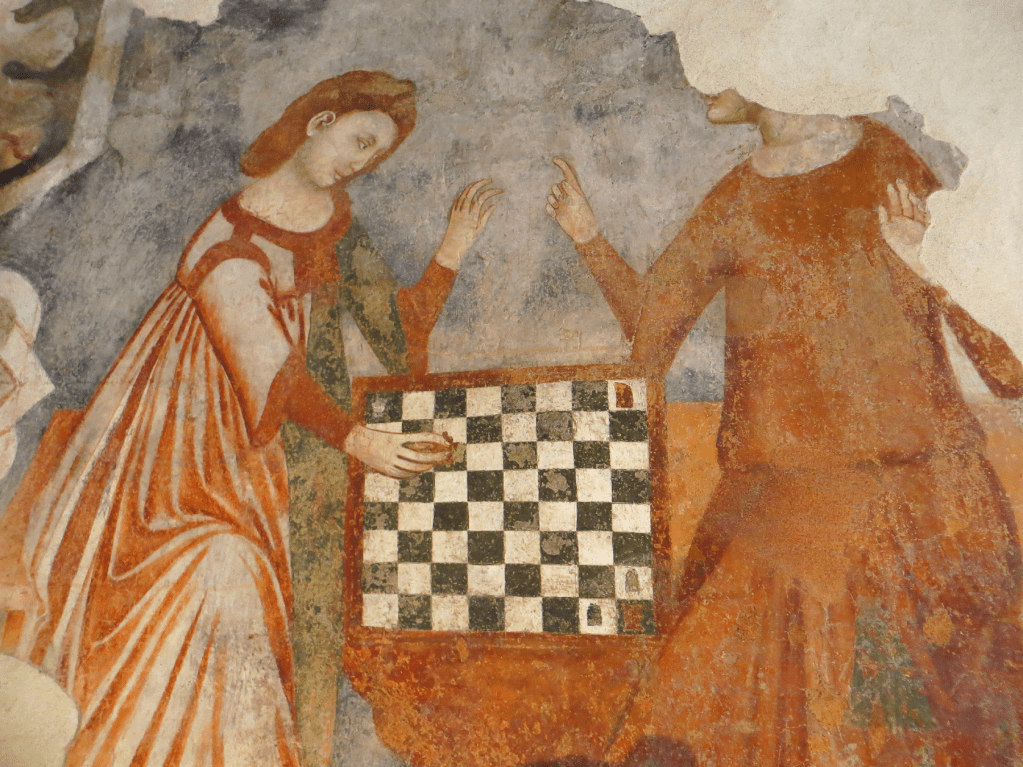
The master of Arco: chess
Jacopo D’Andreamatteo interpreted the picture below as draughts, with its pieces on squares of one color. Italian chess players, however, claim it as chess. Of course. They know chess as the great game of the Middle Ages and know nothing about the existence of medieval draughts. The instructor teaching the game to two young women looks a lot like Dante Alighieri, chess player Alessandro Goio dreamt aloud on his chess site (2013). In 1301 Dante (1265-1321), the Italian poet, was banished from his native city Florence ‒political reasons‒; since then he restlessly wandered along the courts of Central and Northern Italy. Maybe including Arco?
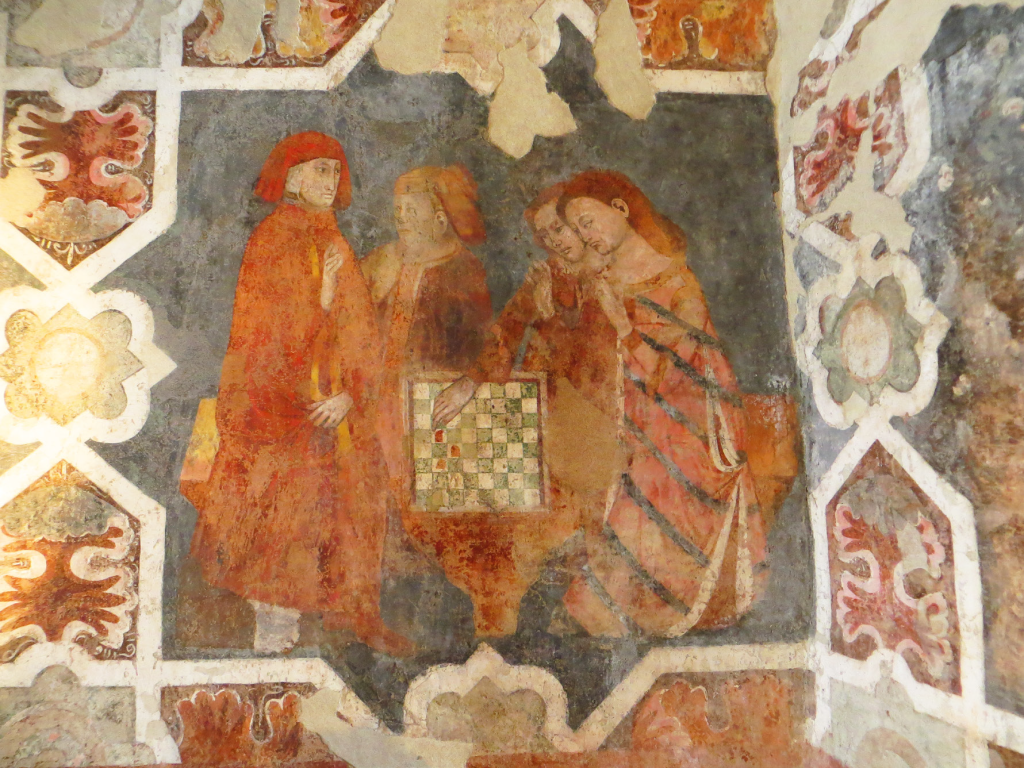
The master of Arco: draughts
I mention this because I see the umpteenth annoying example of creation of a legend around chess. “Napoleon was a strong chess player”; nonsense, see chapter 57. “Chess was the favourite play of the great of the Middle Ages”; twaddle, see chapter 14, chapter 21. “Chess made an essential contribution to the birth of draughts”; a fabrication, see chapter 5.
 draughtsandchesshistory.com